Market Research
Search Import/Export data to understand your markets and monitor your competition.
Learn MoreNeed Shipping Data? call us at +91 639 861 4322

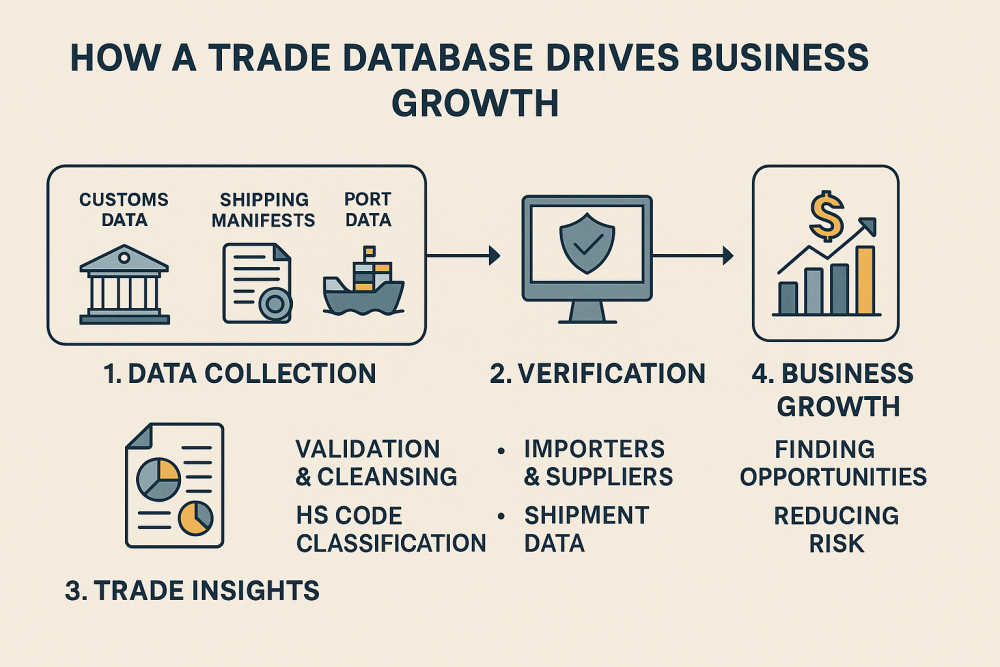
In today’s interconnected marketplace, businesses can no longer rely on intuition alone. They need data — real, verifiable, and actionable. That’s where a Trade Database becomes indispensable. It acts as a bridge between companies and opportunities, revealing who’s buying, who’s selling, and where global demand is shifting.
Whether you’re an established exporter or a startup exploring international markets, trade intelligence derived from a Trade Database empowers smarter decisions, minimizes risk, and accelerates growth. Let’s explore why modern trade data is revolutionizing global business operations and how platforms like TradeExim.in lead this transformation.
Not all trade databases are created equal. The market broadly offers two kinds — public trade databases and private trade databases — each serving a distinct purpose and audience.
Public trade databases are typically maintained by government bodies or international organizations such as the Directorate General of Foreign Trade (DGFT), UN Comtrade, or the World Trade Organization (WTO).
These sources provide macro-level trade statistics, such as total imports and exports per country, trade balances, and HS code categorizations.
Pros:
Cons:
Private trade databases, like the one offered by TradeExim.in, provide detailed, shipment-level data derived from customs records, shipping manifests, and port clearances. They are tailored for businesses seeking specific, real-time insights.
Pros:
Cons:
In short, while public databases give an overview of trade trends, private trade databases deliver actionable intelligence — the kind that drives business strategy and results.
A Trade Database isn’t just a collection of numbers — it’s a roadmap to global success. In today’s data-driven era, businesses use it to understand markets, anticipate trends, and reduce uncertainty.
Here’s how it empowers different stakeholders:
Example Insight:
A Mumbai-based machinery exporter used Exim Trade Data to track global demand for industrial valves. By studying shipment trends from major ports, they identified rising demand in Eastern Europe and established partnerships that boosted exports by 30% in one fiscal year.
That’s the power of a data-backed decision.
In global trade, the most significant challenge is trust — finding genuine partners who deliver what they promise. That’s where a Trade Database becomes a game-changer.
TradeExim.in provides detailed insights, such as:
By cross-referencing supplier records with Exim Trade Data, businesses can verify authenticity and avoid fraudulent listings. For instance, before onboarding a new Chinese component supplier, an Indian electronics firm used TradeExim.in to check their shipment history. They discovered consistent trade activity over three years, confirming credibility before finalizing a contract.
Key Benefit: Access to verified, real-time trade data drastically reduces the risk of counterfeit suppliers or unreliable buyers — ensuring safe, profitable global trade relationships.
Trust in a Trade Database begins with how its information is collected and verified. At TradeExim.in, this process follows strict accuracy and compliance protocols.
This robust verification framework positions TradeExim.in as one of India’s most trusted import export data providers, ensuring accuracy that businesses can depend on.
Let’s look at how a real business leveraged TradeExim.in’s Trade Database to expand globally.
Company: A mid-sized food packaging manufacturer based in Pune, India.
Goal: Find new export opportunities in Southeast Asia.
Challenge: Lack of reliable contacts and understanding of competitive pricing.
Approach:
Using TradeExim.in, the company accessed detailed shipment data from Vietnam, Malaysia, and Thailand. They filtered results using product HS codes to identify top importers of packaging materials.
Findings:
Result:
Within six months, the company signed two new export contracts, increasing overseas revenue by 40%.
This case underscores how TradeExim.in’s Trade Database turns raw data into strategic decisions, helping businesses scale intelligently and confidently.
In an era defined by global connectivity, Trade Databases have become the backbone of business intelligence. From sourcing verified suppliers to tracking competitive movements, every insight contributes to growth and resilience.
Platforms like TradeExim.in go beyond traditional data services — they empower businesses to see the bigger picture through accurate Exim Trade Data, actionable analytics, and a verified import export data provider.
For any company aiming to expand beyond borders, the right data isn’t a luxury — it’s a necessity. A reliable Trade Database transforms uncertainty into opportunity and helps businesses grow with confidence in an ever-changing global landscape.
Submit this form below to get import or export sample data.
Trade Exim offers access to the largest and most extensive collection of import and export data, covering international trade. Whether you seek to generate leads within your local market or expand your business globally, Trade Exim provides the essential resources your enterprise requires.

Search Import/Export data to understand your markets and monitor your competition.
Learn MoreInstantly generate lists of potential customers based on trade activity.
Learn MoreSearch for new suppliers, monitor existing ones and keep track of trends.
Learn MoreTailor a solution specific to your industry, with deep expertise in Chemicals, Transportation, and more.
Learn More